

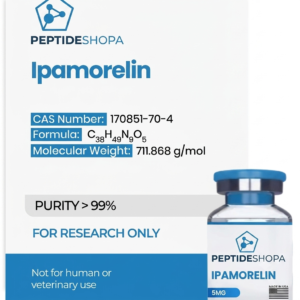



Ipamorelin for sale online : The Selective GH Peptide
How it works, how it compares with CJC-1295, Sermorelin, and Tesamorelin, how to reconstitute it with bacteriostatic water, and exactly what results to expect — week by week.
What Is Ipamorelin?
Ipamorelin is a synthetic pentapeptide — a chain of five amino acids (Aib-His-D-2-Nal-D-Phe-Lys-NH2) — classified as a growth hormone secretagogue receptor (GHSR) agonist. Originally developed by Novo Nordisk in the late 1990s, it was designed to be the most selective growth hormone-releasing peptide (GHRP) of its generation.
What makes ipamorelin stand apart from earlier GHRPs is its selectivity: it stimulates growth hormone release from the pituitary gland without meaningfully raising cortisol, prolactin, or ACTH at therapeutic doses. This cleaner hormonal profile is why it has become one of the most widely studied and clinically used peptides in regenerative and functional medicine.
Ipamorelin is not a synthetic version of growth hormone itself. It does not introduce exogenous HGH. Instead, it signals your own body to produce and release more of its native GH, preserving the natural pulsatile rhythm of secretion. This distinction has significant implications for safety and long-term hormonal regulation.
How Does Ipamorelin Work?
Ipamorelin works by binding to and activating the ghrelin receptor (GHSR-1a) in the hypothalamus and anterior pituitary gland. This activation does two things simultaneously: it reduces the inhibitory signal from somatostatin (the hormone that brakes GH release) and it directly stimulates somatotroph cells to produce and release GH in a sharp, pulsatile burst.
That GH pulse then triggers the liver to release Insulin-like Growth Factor 1 (IGF-1) — the downstream mediator responsible for most of the practical effects: protein synthesis, lipolysis (fat breakdown), tissue repair, and cellular regeneration.
Step 1 Ipamorelin Binds GHSR-1a receptor in pituitary
Step 2 GH Pulse Somatotrophs release endogenous growth hormone
Step 3 IGF-1 Rise Liver produces IGF-1 from circulating GH
Step 4 Tissue Effects Muscle growth, fat loss, recovery, repair
Crucially, ipamorelin preserves the pulsatile, circadian rhythm of GH secretion rather than forcing a continuous elevation. This matters: continuous supraphysiological GH (as with exogenous HGH injections) can desensitize receptors and disrupt natural feedback loops. Ipamorelin respects the body’s existing regulatory system.
Key Benefits of Ipamorelin
Muscle Preservation and Lean Mass
By elevating IGF-1, ipamorelin enhances protein synthesis, activates satellite cells for muscle fiber regeneration, and helps preserve lean mass during caloric deficits or periods of catabolic stress. It is not a mass-building agent in isolation but supports retention and recovery of lean tissue over time.
Fat Loss and Metabolic Support
Growth hormone is directly lipolytic — it signals fat cells to release stored fatty acids for use as fuel. Ipamorelin-driven GH pulses therefore support improved body composition, particularly when combined with appropriate nutrition and resistance training. Results build gradually over weeks to months.
Improved Sleep Quality
Natural GH secretion peaks during deep (slow-wave) sleep. Ipamorelin amplifies this nocturnal GH pulse, which in turn improves sleep architecture. Many users report this as the first and most noticeable effect — typically within 1–2 weeks of initiating a nighttime injection protocol.
Accelerated Recovery
Through IGF-1-mediated pathways, ipamorelin supports faster repair of connective tissue, joints, and muscle fibers following training or injury. Athletes and active individuals often report reduced soreness and improved readiness between sessions.
Anti-Aging Effects
Age-related GH decline (somatopause) is associated with increased body fat, decreased muscle, poorer skin quality, reduced bone density, and cognitive changes. Ipamorelin partially counteracts this decline by restoring more youthful GH pulsatility — without the risks of exogenous HGH.
Selective and Clean Hormonal Profile
Unlike GHRP-2 or GHRP-6, ipamorelin does not meaningfully raise cortisol, prolactin, or ACTH. This makes it the preferred choice in clinical settings where avoiding stress-hormone side effects is a priority, particularly for long-term protocols.
Clinical note: Ipamorelin is often described as the “first truly selective growth hormone secretagogue” because it stimulates GH release without measurably raising cortisol or prolactin at therapeutic doses — a key advantage over older GHRPs.
CJC-1295 and Ipamorelin: Why They’re Paired
The CJC-1295 + Ipamorelin combination is one of the most widely used peptide stacks in clinical peptide therapy — and for good reason. These two peptides work through entirely different receptor pathways, making them synergistic rather than redundant.
| Feature | CJC-1295 (no DAC) | Ipamorelin |
|---|---|---|
| Classification | GHRH analog | GHRP / Ghrelin agonist |
| Receptor | GHRH receptor on somatotrophs | GHSR-1a (ghrelin receptor) |
| Primary action | Tells pituitary to produce GH | Tells pituitary to release GH |
| Half-life (no DAC) | ~30 min – 2 hrs | ~2 hours |
| Cortisol effect | Minimal | Minimal |
| GH pattern | Sustained basal elevation | Sharp pulsatile spikes |
| Together | Synergistic: sustained baseline + amplified pulses = robust GH release | |
Why “No DAC” Matters for the Stack
CJC-1295 with DAC has a half-life of 5–8 days, producing a continuous GHRH signal that doesn’t pair cleanly with ipamorelin’s pulse-based mechanism. CJC-1295 without DAC (also called Modified GRF 1-29) has a half-life of 30 minutes to 2 hours — closely matched to ipamorelin — which preserves the body’s natural pulsatile GH release pattern. The no-DAC variant is the clinically preferred partner for ipamorelin.
CJC-1295 Ipamorelin Benefits (Combined)
When used together, CJC-1295 and ipamorelin create a sequential activity profile: ipamorelin delivers the immediate GH pulse (peak at ~40 minutes), while CJC-1295 extends and amplifies the duration of elevated GH activity. The result is broader, more sustained GH optimization than either peptide achieves alone — translating to better sleep, more pronounced body composition changes, and faster recovery.
The analogy: CJC-1295 loads the gun (builds and stores GH in the pituitary). Ipamorelin pulls the trigger (releases that GH in a pulse). Together, you get both a bigger magazine and a faster rate of fire
Ipamorelin vs Sermorelin
Sermorelin and ipamorelin are both used to stimulate the body’s own GH production, but they differ fundamentally in mechanism, receptor, and clinical behavior.
Sermorelin is a synthetic version of endogenous GHRH — the first 29 amino acids of human growth hormone–releasing hormone. Like CJC-1295, it works through the GHRH receptor, telling the pituitary to produce GH. It has a short half-life (~10 minutes), requires nightly injection, and builds results gradually over weeks to months.
Ipamorelin operates through the ghrelin receptor (a completely different pathway), produces sharper and faster GH pulses, and has the significant advantage of not raising cortisol or prolactin. It also acts more quickly — many users notice improved sleep and recovery within weeks, versus the more gradual build associated with sermorelin.
| Feature | Ipamorelin | Sermorelin |
|---|---|---|
| Pathway | Ghrelin receptor (GHSR-1a) | GHRH receptor |
| Half-life | ~2 hours | ~10 minutes |
| GH pulse speed | Fast and sharp (~40 min peak) | Gradual elevation |
| Cortisol spike | None at therapeutic doses | Minimal |
| Speed of results | Faster (weeks) | Slower (weeks–months) |
| Clinical history | Well-researched since 1990s | Longest track record |
| Selectivity | Highly selective | Moderate |
| Best for | Recovery, body comp, anti-aging | Gentle GH restoration, older patients |
When to choose sermorelin: Sermorelin’s longer history and very gradual mechanism makes it appropriate for patients who want the most conservative approach to GH restoration — particularly older patients or those with significant hormonal sensitivity. Ipamorelin is typically preferred when faster results, better selectivity, or combination with CJC-1295 is desired.
Ipamorelin vs Tesamorelin
Tesamorelin is an FDA-approved GHRH analog (brand name Egrifta) specifically indicated for the reduction of excess visceral abdominal fat in HIV-positive patients with lipodystrophy. Outside this indication, it is used clinically for targeted visceral fat reduction in metabolically challenged patients.
Tesamorelin carries a trans-3-hexenoic acid modification that extends its biological activity to roughly 26 minutes (vs ~10 for sermorelin) and produces greater IGF-1 elevation (30–80% vs 15–30% for sermorelin). Its Phase III trial data demonstrating measurable visceral fat reduction — approximately 15% at 26 weeks — gives it a stronger evidence base for that specific goal than ipamorelin.
| Feature | Ipamorelin | Tesamorelin |
|---|---|---|
| Pathway | Ghrelin receptor (GHSR-1a) | GHRH receptor |
| FDA approval | Not FDA-approved | FDA-approved (HIV lipodystrophy) |
| Visceral fat reduction | Modest, indirect | Clinically validated (~15% at 26 wks) |
| IGF-1 elevation | Moderate | High (30–80%) |
| Cortisol effect | None | Minimal |
| Broad anti-aging | Strong (sleep, recovery, body comp) | Moderate |
| Stack-friendly | Excellent (pairs with CJC-1295) | Can combine with ipamorelin |
| Best for | General GH optimization, recovery | Targeted visceral fat reduction |
Combined protocol: Some clinical protocols combine tesamorelin and ipamorelin — using tesamorelin’s targeted visceral fat-reduction properties alongside ipamorelin’s clean, selective GH pulsing. This stack is used when patients have both metabolic and general wellness goals. Always under medical supervision.
3-Way Comparison: Ipamorelin vs Sermorelin vs Tesamorelin
| Feature | Ipamorelin | Sermorelin | Tesamorelin |
|---|---|---|---|
| Receptor pathway | Ghrelin (GHSR-1a) | GHRH receptor | GHRH receptor |
| Half-life | ~2 hours | ~10 minutes | ~26 minutes |
| Cortisol impact | None | Minimal | Minimal |
| IGF-1 elevation | Moderate | Low–moderate | High (30–80%) |
| Visceral fat loss | Indirect | Indirect | Best evidence |
| Sleep improvement | Fast (wks 1–2) | Gradual | Moderate |
| Recovery & muscle | Strong | Moderate | Moderate |
| FDA status | Not approved | Not approved | Approved (specific use) |
| Best stack partner | CJC-1295 no DAC | GHRP-2, GHRP-6 | Ipamorelin |
| Ideal user | Most patients | Conservative approach | Metabolic / visceral fat |
CJC-1295 Ipamorelin Bacteriostatic Water Mix
Most CJC-1295 + Ipamorelin blends come as a lyophilized (freeze-dried) powder that must be reconstituted with bacteriostatic water (sterile water preserved with 0.9% benzyl alcohol) before use. Here is a standard reconstitution protocol for a 10 mg blend vial (5 mg CJC-1295 + 5 mg Ipamorelin).
// ── Reconstitution Reference ──────────────────────────
Vial contents: 5 mg CJC-1295 + 5 mg Ipamorelin (10 mg total)
BAC water added: 2.0 mL
Final concentration: 5 mg/mL total (2.5 mg/mL each peptide)
// ── Dosing Reference on Insulin Syringe ──────────────
2 units (0.02 mL): 100 mcg total (50 mcg each)
4 units (0.04 mL): 200 mcg total (100 mcg each)
6 units (0.06 mL): 300 mcg total (150 mcg each)
⚠ Do NOT shake. Gently swirl until dissolved.
⚠ Refrigerate at 2–8°C (35–46°F) after mixing.
⚠ Reconstituted vial stable for 8–10 weeks refrigerated.
Step-by-Step Reconstitution Protocol
- 01
Gather supplies : Bacteriostatic water vial, sterile syringe (1–3 mL), alcohol swabs, and the peptide vial. Allow all materials to reach room temperature.
- 02
Clean both stoppers: Wipe the rubber stopper of both the peptide vial and the bacteriostatic water vial with an alcohol swab. Allow to air-dry for 10 seconds.
- 03
Draw bacteriostatic water: Draw up 2.0 mL of bacteriostatic water into a sterile syringe. Expel any air bubbles before proceeding.
- 04
Inject slowly along the vial wall: Insert the needle into the peptide vial and slowly inject the bacteriostatic water down the inside wall of the glass — not directly onto the powder. This prevents foaming and peptide degradation.
- 05
Gently swirl — never shake: Gently roll or swirl the vial until the powder is completely dissolved. Do not shake vigorously — agitation can denature the peptide chain and reduce potency.
- 06
Label and refrigerate: Label the vial with the date of reconstitution. Store immediately at 2–8°C (35–46°F), protected from direct light. Do not freeze. The reconstituted solution is stable for approximately 8–10 weeks.
Important: Bacteriostatic water (not sterile water, not saline) is the correct diluent. The benzyl alcohol preservative in BAC water prevents bacterial growth over the vial’s multi-week life. Using plain sterile water will shorten stability to approximately 24 hours.
CJC-1295 Ipamorelin Dosage Per Day
The following dosage framework reflects commonly referenced clinical protocols. All peptide therapy must be individualized by a licensed medical provider based on patient labs, age, body weight, and treatment goals. This information is educational, not a personal prescription.
| Protocol Level | CJC-1295 (no DAC) | Ipamorelin | Frequency | Cycle |
|---|---|---|---|---|
| Starter / Titration | 100 mcg | 100 mcg | Once daily, before bed | Weeks 1–2 |
| Standard (most users) | 200 mcg | 200 mcg | Once daily, before bed | 8–12 weeks |
| Advanced | 300 mcg | 300 mcg | Daily or split AM/PM | 12–16 weeks |
| Off-cycle break | 4 weeks off after each 8–12 week cycle (or 8 weeks off after 16-week cycle) | |||
Timing: Why Before Bed?
The body’s natural GH secretion peaks during the first few hours of deep sleep. Injecting ipamorelin (and CJC-1295) 30–60 minutes before bedtime aligns the peptide-driven GH pulse with the natural nocturnal surge, amplifying rather than overriding the body’s own rhythms. Food in the stomach blunts GH release, so injections should be taken on an empty stomach — ideally at least 2 hours after the last meal.
CJC-1295 Ipamorelin Results Timeline
Results from the CJC-1295 + ipamorelin protocol follow a consistent, progressive pattern. Here is what the evidence and clinical experience suggest, week by week.
Weeks 1–2: First Changes
Most users report improved sleep quality as the earliest effect — often within the first week. The enhanced nocturnal GH pulse deepens slow-wave sleep, producing more vivid dreams, easier sleep onset, and more refreshed waking. Some notice a mild increase in energy during the day.
Weeks 3–4: Recovery and Energy
Recovery between training sessions accelerates. Muscle soreness diminishes more quickly, joint comfort often improves, and many users experience a clearer, more sustained daily energy level. Libido improvements are sometimes noted at this stage.
Weeks 5–8: Body Composition Shifts Begin
Increased GH and IGF-1 activity begins to produce measurable changes in body composition. Users on appropriate nutrition plans notice fat loss (particularly in the abdominal region) and initial improvements in muscle fullness and tone. Skin quality often improves — better hydration, reduced appearance of fine lines.
Weeks 8–12: Peak Visible Results
The cumulative effect of sustained GH optimization becomes most apparent. Significant body composition improvements are now measurable — both visually and on DEXA scanning if used. Lean mass is better preserved, visceral fat is reduced, recovery is noticeably faster, and overall vitality and mood are improved. IGF-1 labs at this point typically confirm elevation.
Weeks 12–16: Sustained Optimization (Advanced Protocols)
Advanced protocols extending to 16 weeks show continued gains in body composition, bone density markers, and connective tissue integrity. An off-cycle period of 4–8 weeks follows, during which many benefits are maintained before the next cycle begins.
Side Effects and Safety
Ipamorelin’s highly selective mechanism gives it one of the best safety profiles among GH-stimulating peptides. Reported side effects are generally mild and often dose-dependent.
| Side Effect | Frequency | Notes |
|---|---|---|
| Injection site redness / irritation | Common | Typically resolves in minutes; rotate injection sites |
| Water retention / mild bloating | Common early | Usually subsides after the first 1–2 weeks |
| Headache (initial) | Occasional | Often a titration effect; reduce dose if persistent |
| Tingling / numbness (hands/feet) | Occasional | Carpal tunnel-like effect at higher doses; dose-dependent |
| Increased hunger | Occasional | Mild, unlike GHRP-6 which causes pronounced hunger |
| Cortisol elevation | Rare | Key advantage over older GHRPs — not seen at therapeutic doses |
| Prolactin elevation | Not observed | Ipamorelin’s defining safety feature |
Frequently Asked Questions
What is the difference between ipamorelin and sermorelin?
Sermorelin works through the GHRH receptor and tells the pituitary to produce GH — it’s a GHRH analog. Ipamorelin works through the ghrelin receptor (GHSR-1a) and triggers the actual GH pulse. They use different pathways, but ipamorelin tends to act faster, has a cleaner hormonal profile (no cortisol spike), and pairs better with CJC-1295 for synergistic protocols.
Is ipamorelin better than tesamorelin?
Neither is universally better — they have different strengths. Tesamorelin is FDA-approved and has the strongest clinical evidence specifically for reducing visceral abdominal fat. Ipamorelin is broader in its benefits (sleep, recovery, body composition, anti-aging) and has a more selective hormonal profile. Many clinical protocols combine both for patients with metabolic and general wellness goals simultaneously.
Can I use CJC-1295 with DAC instead of no DAC?
For pairing with ipamorelin, no-DAC is strongly preferred. CJC-1295 with DAC has a half-life of 5–8 days and produces a sustained, non-pulsatile GHRH signal that doesn’t match well with ipamorelin’s pulse-based mechanism. No-DAC’s shorter half-life (~30 min–2 hrs) mirrors ipamorelin’s, preserving the natural pulsatile GH release pattern that is one of ipamorelin’s key safety advantages.
How long does a reconstituted CJC-1295/ipamorelin vial last?
When properly reconstituted with bacteriostatic water and stored at 2–8°C (35–46°F), a mixed vial is typically stable for 8–10 weeks. Do not freeze the reconstituted solution. Always discard if the solution becomes cloudy, discolored, or develops particles.
What is the best time of day to inject CJC-1295 and ipamorelin?
The optimal timing is 30–60 minutes before bedtime, on an empty stomach (at least 2 hours after your last meal or snack). This aligns the peptide-driven GH pulse with the body’s largest natural nocturnal GH release, amplifying rather than disrupting normal hormonal rhythms. Some advanced protocols add a second injection in the morning — also fasted.
How fast does ipamorelin work?
Sleep improvements are typically noticed within 1–2 weeks. Enhanced recovery and energy appear in weeks 3–4. Visible body composition changes — reduced fat, improved muscle tone — become apparent between weeks 8–12. Full structural results accumulate over a complete 12-week cycle and often improve further in subsequent cycles.
Does ipamorelin cause water retention?
Mild, temporary water retention is sometimes reported during the first 1–2 weeks as GH activity increases. This is generally self-resolving and much less pronounced than what is seen with exogenous HGH injections. Reducing sodium intake and staying well-hydrated during the initial weeks can help minimize this effect.
Medical Disclaimer
This article is intended for informational and educational purposes only. Ipamorelin, CJC-1295, sermorelin, and tesamorelin are peptides used in clinical research and medical practice contexts. Ipamorelin and CJC-1295 are not FDA-approved for general wellness or anti-aging use. Tesamorelin is FDA-approved only for the treatment of HIV-associated lipodystrophy. Dosage, cycle, and protocol information presented here is educational and does not constitute medical advice, diagnosis, or prescription. Always consult a licensed, qualified medical provider before beginning any peptide therapy. Individual responses to peptides vary and are influenced by age, baseline labs, health status, diet, and activity level.
References
- Raun K, Hansen BS, Johansen NL, Thøgersen H, Madsen K, Ankersen M, Andersen PH. Ipamorelin, the first selective growth hormone secretagogue. Eur J Endocrinol. 1998 Nov;139(5):552-61. doi: 10.1530/eje.0.1390552. PMID: 9849822.
- Johansen PB, Nowak J, Skjaerbaek C, Flyvbjerg A, Andreassen TT, Wilken M, Orskov H. Ipamorelin, a new growth-hormone-releasing peptide, induces longitudinal bone growth in rats. Growth Horm IGF Res. 1999 Apr;9(2):106-13. doi: 10.1054/ghir.1999.9998. PMID: 10373343.
- Sinha DK, Balasubramanian A, Tatem AJ, Rivera-Mirabal J, Yu J, Kovac J, Pastuszak AW, Lipshultz LI. Beyond the androgen receptor: the role of growth hormone secretagogues in the modern management of body composition in hypogonadal males. Transl Androl Urol. 2020 Mar;9(Suppl 2):S149-S159. doi: 10.21037/tau.2019.11.30. PMID: 32257855; PMCID: PMC7108996 https://www.ncbi.nlm.nih.gov/pmc/articles/PMC7108996/
- Jiménez-Reina, L., Cañete, R., de la Torre, M. J., & Bernal, G. (2002). Influence of chronic treatment with the growth hormone secretagogue Ipamorelin, in young female rats: somatotroph response in vitro. Histology and histopathology, 17(3), 707–714. https://doi.org/10.14670/HH-17.707
- Gobburu, J.V.S., Agersø, H., Jusko, W.J. et al. Pharmacokinetic-Pharmacodynamic Modeling of Ipamorelin, a Growth Hormone Releasing Peptide, in Human Volunteers. Pharm Res 16, 1412–1416 (1999).
- Andersen NB, Malmlöf K, Johansen PB, Andreassen TT, Ørtoft G, Oxlund H. The growth hormone secretagogue ipamorelin counteracts glucocorticoid-induced decrease in bone formation of adult rats. Growth Horm IGF Res. 2001 Oct;11(5):266-72. doi: 10.1054/ghir.2001.0239. PMID: 11735244.
- Svensson, J., Lall, S., Dickson, S. L., Bengtsson, B. A., Rømer, J., Ahnfelt-Rønne, I., Ohlsson, C., & Jansson, J. O. (2000). The GH secretagogues ipamorelin and GH-releasing peptide-6 increase bone mineral content in adult female rats. The Journal of endocrinology, 165(3), 569–577. https://doi.org/10.1677/joe.0.1650569
- Adeghate E, Ponery AS. Mechanism of ipamorelin-evoked insulin release from the pancreas of normal and diabetic rats. Neuro Endocrinol Lett. 2004 Dec;25(6):403-6. PMID: 15665799.
- Aagaard, N. K., Grøfte, T., Greisen, J., Malmlöf, K., Johansen, P. B., Grønbaek, H., Ørskov, H., Tygstrup, N., & Vilstrup, H. (2009). Growth hormone and growth hormone secretagogue effects on nitrogen balance and urea synthesis in steroid treated rats. Growth hormone & IGF research: official journal of the Growth Hormone Research Society and the International IGF Research Society, 19(5), 426–431. https://doi.org/10.1016/j.ghir.2009.01.001
- Childs MD, Luyt LG. A Decade’s Progress in the Development of Molecular Imaging Agents Targeting the Growth Hormone Secretagogue Receptor. Mol Imaging. 2020 Jan-Dec;19:1536012120952623. doi: 10.1177/1536012120952623. PMID: 33104445; PMCID: PMC8865914.
- Greenwood-Van Meerveld B, Tyler K, Mohammadi E, Pietra C. Efficacy of ipamorelin, a ghrelin mimetic, on gastric dysmotility in a rodent model of postoperative ileus. J Exp Pharmacol. 2012 Oct 19;4:149-55. doi: 10.2147/JEP.S35396. PMID: 27186127; PMCID: PMC4863553.
- Lall, S., Tung, L. Y., Ohlsson, C., Jansson, J. O., & Dickson, S. L. (2001). Growth hormone (GH)-independent stimulation of adiposity by GH secretagogues. Biochemical and biophysical research communications, 280(1), 132–138. https://doi.org/10.1006/bbrc.2000.4065
| Brand | Biotech Peptides |
|---|
Related products