




Mod GRF 1-29 Peptide for Sale — Research Use Only
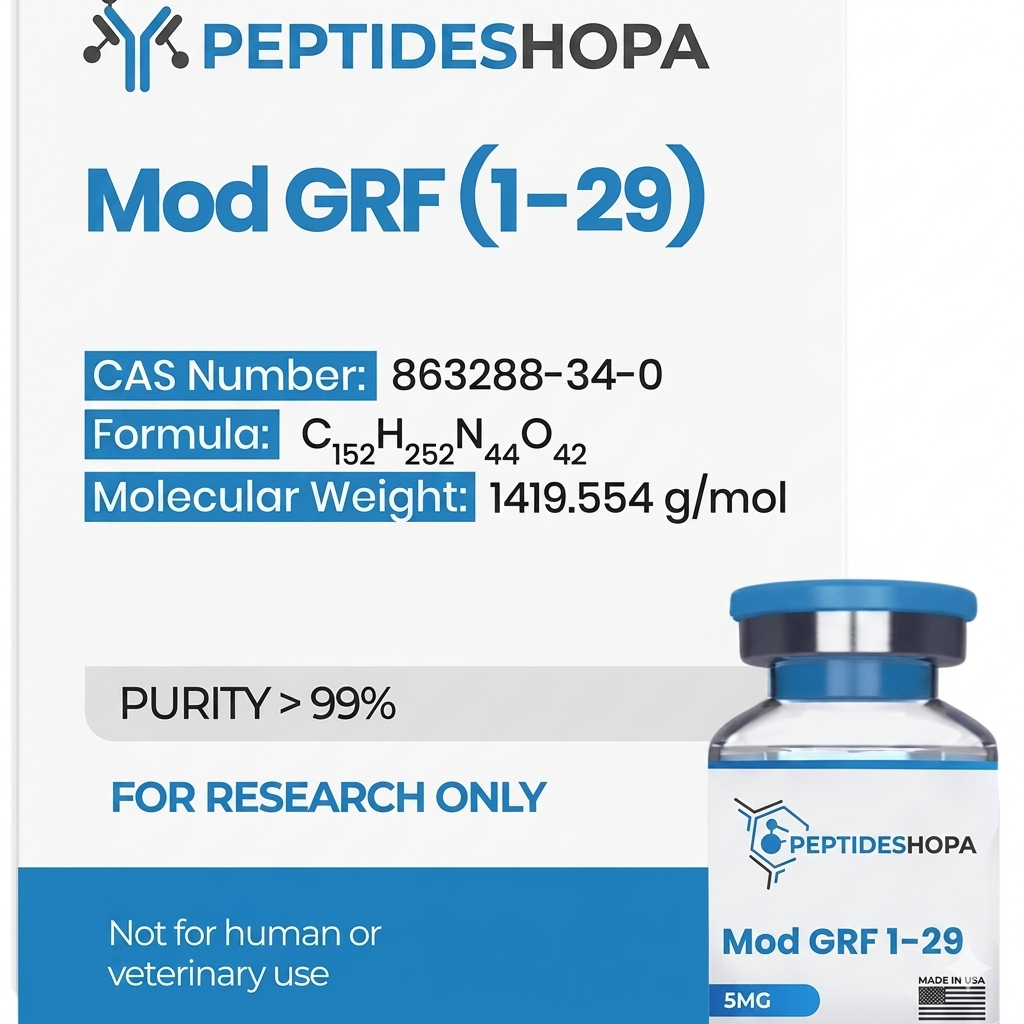
Mod GRF 1-29 — also sold under the name CJC-1295 no DAC — is a research peptide available at Peptide Shopa, synthesized in the USA and batch-tested for purity. Mod GRF 1-29 is intended strictly for laboratory and scientific research use. It is not approved for human or veterinary use, diagnosis, treatment, cure, or prevention of any disease.
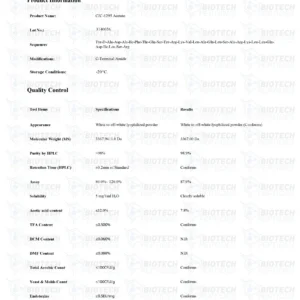
Every batch ships with documentation supporting purity and identity, and a Certificate of Analysis (COA) is available on request so researchers can verify what they’re working with before it reaches the bench.
What Is Mod GRF 1-29?
Mod GRF 1-29 is a synthetic, truncated analog of growth hormone-releasing hormone (GHRH). It was developed after 1980s-era research suggested that the first 29 amino acids of the full 44-amino-acid GHRH molecule retained the hormone’s full biological activity on its own — giving rise to the original GRF (1-29) fragment, also referred to in research literature as Sermorelin.
“Mod GRF 1-29” refers to a further-modified, tetra-substituted version of that fragment. Four amino acid substitutions — at positions 2, 8, 15, and 27 — were introduced to improve resistance to enzymatic degradation, particularly from the enzyme DPP-4. The result is a peptide researchers consider far more stable in experimental models than the original unmodified fragment, while still acting on the same GHRH receptor pathway in the anterior pituitary.
Because this tetra-substituted version is chemically identical to what’s marketed as CJC-1295 without DAC, the two names are used interchangeably across the research peptide market — they describe the same molecule.
Quick specs:
| Property | Detail |
|---|---|
| Also known as | CJC-1295 no DAC, tetrasubstituted GRF (1-29) |
| Classification | GHRH analog (truncated, modified fragment) |
| Form | Lyophilized powder, USA-synthesized |
| Storage | Lyophilized vials should be stored in a freezer prior to reconstitution; refer to COA and product insert |
| Intended use | Laboratory and in-vitro/in-vivo research only |
| Human/veterinary use | Not approved — research use only |
Mod GRF 1-29 vs. CJC-1295 (with DAC) vs. Sermorelin
These three names get confused constantly in research-peptide discussions, so here’s a direct comparison:
| Mod GRF 1-29 (CJC-1295 no DAC) | CJC-1295 (with DAC) | Sermorelin (GRF 1-29, unmodified) | |
|---|---|---|---|
| Structure | Tetra-substituted GHRH fragment | GRF 1-29 fragment + DAC (Drug Affinity Complex) | Unmodified GRF 1-29 fragment |
| Half-life in research models | Extended vs. unmodified GRF, shorter than DAC version | Several days — the longest of the three | Minutes — rapidly degraded |
| Why it’s studied | Improved enzymatic stability for short-to-mid window study designs | Long-duration exposure studies | Baseline/reference compound; original GHRH-fragment research |
| Relationship to GHRH receptor | Binds and activates, same pathway as native GHRH | Binds and activates, same pathway | Binds and activates, same pathway |
In short: Sermorelin is the original, short-lived fragment. Mod GRF 1-29 modifies that fragment for better stability. CJC-1295 with DAC goes a step further by attaching a Drug Affinity Complex for an even longer half-life. Researchers choose between them based on the exposure window their study design requires.
Reported Research Findings on Mod GRF 1-29
The following points summarize what’s been reported in published and preclinical research literature. This information is provided for educational and research-planning purposes — it describes observations in experimental and cell-culture models, not effects in humans, and is not a claim that Mod GRF 1-29 treats, cures, or prevents any condition.
Research models studying Mod GRF 1-29 (and its parent compound GHRH) have reported:
- Growth hormone secretion — Studies on related tetra-substituted GRF analogs have reported substantial increases in growth hormone release from anterior pituitary somatotroph cells, with one frequently cited study reporting a 70–107% rise in average 12-hour GH output following exposure.
- Downstream IGF-1 modulation — Research has examined effects on the growth hormone–IGF-1 axis, looking at how increased GH pulses correspond to changes in IGF-1 levels in experimental models.
- Tissue and metabolic research applications — Published research on the broader GHRH/GRF family has explored roles in muscle tissue hypertrophy, wound healing, bone density, fat metabolism, and immune system markers in animal and cell-based models.
- Receptor-binding mechanism — Mod GRF 1-29 is studied for its interaction with GHRH receptors in the pituitary, where binding is believed to trigger intracellular signaling cascades that promote GH release.
It’s worth noting directly: no studies have specifically and exclusively investigated the tetra-substituted Mod GRF 1-29 molecule in isolation at scale. Much of the literature draws on closely related GRF (1-29) and GHRH research, which is why findings are described as applicable to the broader analog family rather than as compound-specific clinical conclusions.
These findings come from cell-culture and animal-model research, plus literature on closely related GHRH fragments. None of this constitutes evidence of safety or efficacy in humans, and Peptide Shopa does not sell Mod GRF 1-29 for human consumption.
Mod GRF 1-29 & Ipamorelin: A Commonly Studied Pairing
Mod GRF 1-29 and Ipamorelin are frequently referenced together in research discussions because they act on different receptor pathways. Mod GRF 1-29 works through the GHRH receptor, while Ipamorelin is a selective ghrelin-receptor (GHS-R) agonist. Research models exploring growth hormone secretagogues have looked at whether combining a GHRH-pathway compound with a ghrelin-pathway compound produces a more pronounced GH pulse than either compound studied in isolation — since the two pathways are not mutually exclusive.
This is a research question being explored across the peptide research community, not a recommended combination protocol. Peptide Shopa stocks both compounds separately for laboratories designing their own comparative or combination study protocols.
Reconstitution & Storage Guidelines for Research Use
For laboratories preparing Mod GRF 1-29 for in-vitro or animal-model research, standard peptide-handling protocols apply:
- Prior to reconstitution: Store lyophilized vials in a freezer, protected from light.
- Reconstitution: Use bacteriostatic or sterile water appropriate for peptide research applications, added slowly down the side of the vial to avoid disrupting the lyophilized structure.
- After reconstitution: Store refrigerated and use within the timeframe indicated on the product documentation; avoid repeated freeze-thaw cycles, which can degrade peptide integrity.
- Handling: Always reference the Certificate of Analysis and product insert that ships with your order, and follow your institution’s standard laboratory safety protocols.
These guidelines describe laboratory sample preparation for research purposes only. They are not instructions for human or animal administration.
Why Researchers Choose Peptide Shopa
- USA Synthesized — Sourced through vetted U.S. manufacturing partners.
- Quality Tested — Batch testing supports purity and consistency from lot to lot.
- COA Available — Certificate of Analysis provided so researchers can independently verify product specs.
- Transparent Fulfillment — Clear documentation, responsive support, and secure ordering (bank transfer, Bitcoin, Apple Pay, PayPal).
Frequently Asked Questions
Is Mod GRF 1-29 the same as CJC-1295? Mod GRF 1-29 and “CJC-1295 no DAC” refer to the same tetra-substituted molecule. “CJC-1295” alone, without the “no DAC” qualifier, usually refers to a different, longer-acting version that includes a Drug Affinity Complex (DAC). Always check a product listing’s full name and sequence to confirm exactly which version you’re ordering.
Is Mod GRF 1-29 legal to purchase? Mod GRF 1-29 is not approved by the FDA for human or veterinary use. It is legally sold in the U.S. for research purposes only, typically purchased by laboratories, research institutions, and qualified researchers. Peptide Shopa sells Mod GRF 1-29 strictly under this research-use designation.
Does Peptide Shopa provide a Certificate of Analysis? Yes. COA documentation is available for batches so researchers can verify purity and identity before use in a study.
I’ve seen “Mod GRF 1-29 dosage” discussed on Reddit and bodybuilding forums — does Peptide Shopa provide usage instructions? No. Peptide Shopa does not provide, and cannot provide, instructions for administering Mod GRF 1-29 to humans or animals, because the compound is not approved for that use. Forum discussions reflect individual, unverified accounts and are not a substitute for the peer-reviewed research literature referenced on this page. Researchers should consult primary scientific sources and their institution’s protocols.
How does Mod GRF 1-29 compare to Sermorelin? Sermorelin refers to the original, unmodified GRF (1-29) fragment, which has a very short half-life in research models. Mod GRF 1-29 introduces four amino acid substitutions specifically to improve stability against enzymatic breakdown, giving researchers a longer experimental window while acting on the same GHRH receptor pathway.
How should Mod GRF 1-29 be stored? Lyophilized Mod GRF 1-29 should be kept frozen and protected from light prior to reconstitution. See the Reconstitution & Storage Guidelines section above and the product-specific COA for full handling details.
Research Use Only Disclaimer
All products offered by Peptide Shopa, including Mod GRF 1-29, are intended strictly for laboratory and scientific research purposes only. Products are not intended for human consumption, veterinary use, diagnosis, treatment, cure, or prevention of any disease. Researchers are responsible for reviewing all product documentation, handling materials appropriately, and complying with applicable laws and regulations in their jurisdiction.
References
- Khorram, O., Garthwaite, M., & Golos, T. (2002). Growth hormone-releasing hormone agonist (CJC-1295) increases GH and IGF-1 secretion. Endocrine research findings cited in subsequent literature reviews.
- Ionescu, M., & Frohman, L. A. (2006). Pulsatile secretion of growth hormone (GH) persists during continuous stimulation by CJC-1295. Journal of Clinical Endocrinology & Metabolism.
- Teichman, S. L., et al. (2006). Prolonged stimulation of growth hormone (GH) and insulin-like growth factor I secretion by CJC-1295. Journal of Clinical Endocrinology & Metabolism, 91(3), 799–805.
| Brand | Biotech Peptides |
|---|
Related products